Before it goes to press: Editing
Someone a long time ago, when I first embarked on this writing journey, told me I better really like my story because I would be reading it a zillion times.
Truer words were never spoken. OK, maybe the zillion is an exaggeration, but it certainly seems like it.
The current book I am writing is on version ~15. And that’s not even counting very accurately. It has been five years since inception. And at each version I likely read the story front to back 2-3 times, making edits and changes each time.
Before a book is published, the editing process cleans up the manuscript so that when you actually get to the Publish point, the story is as tight and free of errors as possible. Everything—from each word on the page (front, back and body copy) is ready for the reader. Here’s how getting your writing to the Publish state happens.
There is method to this madness, stay with me. At each pass, editing focuses on different aspects of the story. The four main editing types are:
- Developmental
- Line
- Copy
- Proof
These different types can happen linearly or, depending on changes made, iteratively.
Developmental Editing
Generally, this happens early in the book editing process. The story is done (pretty much) and the developmental edit focuses on the big picture of the book—do the parts hang together? Are the characters fleshed out? Does the story flow? Are there any continuity breaks? Does the story make sense?
Two types of writers—Pantsers or Planners—Can use the developmental editing at different points in their writing process. A Pantser is a writer that writes by “the seat of their pants.” Often they write relying on their pen (or keyboard) leading the way and creating the story, characters, and flow of the story as they write. They may not use a Developmental editor until a working draft is done. The Planner may outline the story, characters, timelines before ever writing the first word. Because of this, the Planner may have a better idea of the story development, which characters need to be more fully developed, highs and lows that creates the arc of the story. A Planner may use Developmental editing on their outline and on a written draft. Writers in both styles exist and have success.
The developmental editor then reads the story considering how it all hangs together and where improvements can happen. The writer takes that input and writes to improve the story.
Line editing
A line editor does as the title implies: reads line by line (sentence by sentence) and cleans up the writing at the sentence level. Do the sentences flow together? Are they clear, written in the same tone or style? Do the paragraphs make sense together? This stage doesn’t focus on grammar—it is more of a polishing stage.
Copy editing
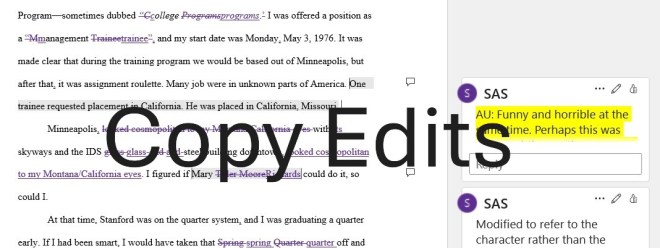
Here’s where the going gets nitty gritty. A copy edit dives into grammar, punctuation, and makes sure the language usage is correct. Copy editors use style manuals as their guide. Some style manuals that are used frequently are Chicago Manual of Style, AP Stylebook, New Oxford Style Manual. The first time I had a copy edit done my document came back with so many flags, comments and change tracking markups I was ready to cry. It actually wasn’t that bad.
In my opinion, copy editing is critical for presenting a clean, well-written manuscript for publishing. If you are going to spend money on a professional, this is the place to do it.
Proof reading
You’ve made it through these editing steps, your writing is tweaked and smoothed and scenes rewritten and reviewed. You may be ready to Publish! Maybe you even have an advanced copy. Now, before you distribute the book to the readers of the world, the opportunity for one last look is here. Proofreading is a time to catch any last errors before the book is published and available to the world.
Love the book you’ve written because if you go through with every editing stage above, it’s clear that there is a lot of reading, reworking, rewriting, rethinking that takes place. The redeeming factor is in the end you have a story that you can be proud of and is as error free as possible!!
Go for it!
 ELAINE KOYAMA WRITES