I have said before that I didn’t get punished much growing up, and I attribute it to the fact that I had seven older siblings who chastised me frequently, but even they didn’t scold me much. As I reflect on how I parented my kids, it seems like I was after them all the time. They didn’t get away with anything (that I knew about), and I feel as though I scolded them frequently. I wonder now how that might have affected them, their self-esteem, their view of the world. I think about it because I was not scolded nor disciplined as a kid hardly at all. I have written about the three major punishments I endured as a kid and it has to affect the way a person looks at the world if there is so little discipline.
Which leads me to times in my youth that I should have been punished, but wasn’t. Yes, I remember getting away with doing things that definitely would have merited consequences. I may have dodged the bullet, been just lucky, or maybe just dumb. I’ll never know.
I played alone most of the time growing up. Two of my brothers were three and five years older, and my nearest sister was like seven years older. I was too little to really “play” with. I liked to pretend to drive, like most kids. I’d get behind the wheel of a parked car or truck or tractor an spin the steering wheel around like I was going to town.
The Big Horn River valley is a farming community rich because of the river that runs through it. Upstream canals were dug and built by the Civilian Conservation Corps (CCC) during the 1930s. Through a series of ditches, the water is diverted to fields all over the valley. The farm fields are leveled flat and the crops are planted in rows that are created by V shaped shovels that are pulled behind the tractor. The mounded rows are important because we irrigated by using siphon tubes that are hand started at a ditch the ran perpendicular to the top of the field and the rows. Sometimes we had an irrigation tube for every row, sometimes it was every other row. It was amazingly labor intensive. When I was older I often lugged tubes from the section that was finished to the next set of rows to irrigate. It seemed like hundreds of tubes, but it was probably only fifty or seventy five tubes at a time. It was a constant job as we’d “set” the water (get the 50-75 tubes siphoning from the ditch to the field) and then we would wait for the water to make it to the end of the field where there would be a shallower ditch to catch the water that made it to the end of the field.
Like so many labor intensive jobs, it was frustrating when something would go wrong. Maybe a row or two would break through and the water would not flow all the way down, leaving those rows of plants without water. Farmers would have fights over water as there were head gates all over the ditch system that diverted the water to everyone’s field. I heard my dad get into it with neighbors who opened a head gate without telling him, and then the water level would drop to our fields. That was a problem because when the water dropped, the siphon tubes could lose their suction, and we would have to re-set the section of field affected.
All this I learned much later in my teens. When I was five or six, I would not play in the ditches–we lived in fear of water and drowning–but I would go to the corner of the horse pasture where I’d play on the concrete head gate. What was cool about the head gate (to a five year old) was jumping over the water from one concrete wall to the other, maybe two feet across but with rushing water below. And these fun steering wheel things that I would, like driving a car, turn them this way and that, pretending I was on a great adventure, driving to the mountains or to the big city.
These wheels were fun, too, because when they were turned, this screw would go up or down in the middle of it. Sometimes I would turn the wheel just to see how high or low the screw would go. The screw was maybe an inch and a half in diameter and it would go up about a foot. I could play for hours at the head gate. And it was close to the house so I could run home anytime I wanted.
Well, now as an adult, I know that I was playing with the irrigation water. By turning that head gate wheel, I was opening and closing the water that was flowing to the irrigation tubes. How many sets of water did I screw up by closing the gate? How many extra hours of work did I create by my play? I’ll never know, and maybe the damage wasn’t so great. The guys that did the irrigation back then were hired hands and my brothers. It wasn’t until much later did I get enlisted to help and I understood what I had done to the process.
I never got punished for it, maybe because they never figured out who had been messing with the head gates. For all I know, my dad fought with the neighbor blaming them for diverting water to their fields.
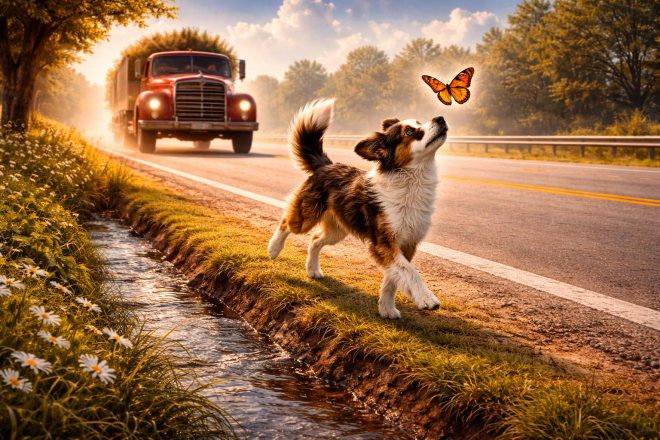
I quit going out to play at the irrigation head gates one summer day when I was there jumping over the water with a collie puppy we had recently gotten. The dog and I were playing on the cement when a butterfly came fluttering by. That dumb dog loved butterflies, and he started following it, his nose in the air pointed at the butterfly.
I called his name, he didn’t come back. We lived on Highway 47, the main road north out of town. A big truck came by and hit the dog. I stood on the cement, calling his name, but he was only a puppy, fascinated by butterflies. I was frozen, knowing I couldn’t run out to save the dog, knowing he was going to get hit, thinking how stupid following a butterfly was.
I ran home and told my mom. I went into a bedroom and hid. I can’t remember crying but I am sure I did. The man who was driving the truck came to the door. My mom answered and talked to him, but I didn’t go out.
That’s farm life, and maybe while I didn’t get punished by anyone for shutting off irrigation water, I was punished by a more powerful messenger.
 ELAINE KOYAMA WRITES