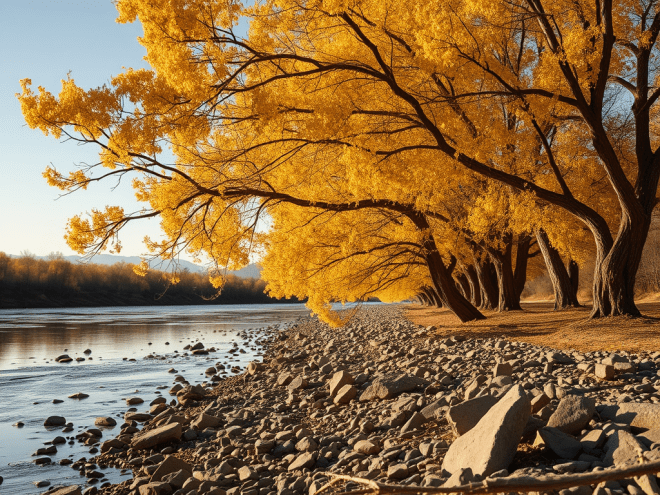
I never liked cottonwood trees. They seemed so gnarly, their bark rough, grooved, scratchy. In the early summer, the cotton from the trees would make the yard look like a snowstorm had struck. As an adult, I had to brush, power wash and clear the air-conditioning condenser of the cotton that would get sucked into the fan screen and make the air conditioner ice up and fail.
In eastern Montana, the cottonwood was one of the few trees that would grow in the river valleys, gullies, and along irrigation canals. There was a row of old cottonwoods that lined the ditch that ran through the horse pasture, planted when my parents first moved to the farm in the 1940s. As a teenager, my bedroom window faced the row of trees, then thirty years older. They were huge. I knew each one, their unique limbs reaching out, some easier to climb than others.
Outside my west facing window was another cottonwood, close enough to the house for me to climb, scooch out on a large limb that reached over the porch, and from that branch I could get up on the roof of the house.
I learned how to climb from my brothers, Robert and Harry. I think my cat at the time, Mickey, learned how to climb the tree and get to the roof from me.
My writing desk as a kid faced north and I could see the cottonwoods down by the Big Horn River turn golden in the fall. The river was probably two miles away, but close enough that I could appreciate the brief glow of gold before the leaves fell and the cold hand of winter had us in its grip.
Now I am old.
The first time I went down to the banks of the Rio Grande I noticed all the cottonwoods. It was springtime, so the water flow was aggressive. The leaves were on the brink of full bloom. The dead leaves from the winter still littered the path—brown, brittle triangular-shaped, they had drifted against logs and rocks. It felt like home. I was transported to my childhood, to a time when I would ride my bay saddle horse down by the river, wandering through the cottonwoods, sunlight filtering through the leaves, the smell of rotting organics mixed with the fresh green leaves and grasses. I could hear, but not see, the river flowing against the bluffs. The trees became the windows to the world outside of my youth—they loomed above me, sheltering me but also rousing me to imagine a world beyond the trees.
Back then, I thought cottonwoods offered nothing of value. Maple trees—or oaks—those were the trees that I longed for. Maples gave us the spectacular fall reds and oranges and yellows. Oak trees gave us acorns, hardwood and leaves that were more subtlety red and orange and finally their burnt, burnished reds would signal winter. Cottonwoods? Only yellow.
Only yellow.
I’ve moved nine hundred miles from my childhood home on the Big Horn River to Santa Fe. I drive from Santa Fe to Albuquerque at least once a week, this week it’s been three times. Fall comes to New Mexico later than in Montana. I am sure all the leaves have fallen from the Montana cottonwoods. But the cottonwood trees in New Mexico are at peak colors this first week of November.
As I drive from Santa Fe to Albuquerque and back, I relish in the yellow glow that emanates from the Rio Grande cottonwoods. My heart swells.
The trees of my youth inspired me to dream big. The trees of my old age remind me I am not so far from home; that somewhere in my self I am still that young girl.
I don’t hate cottonwoods.
I love cottonwoods.
 ELAINE KOYAMA WRITES
Thank you for the beautiful reflection, Elaine.
Micah
Micah Chang
Assistant Professor of History
Department of History & Philosophy
Montana State University | Bozeman, MT
LikeLike
Beautiful, Elaine! I too love cottonwoods and the magnificent color they bring in the fall, and their gnarly old trunks. Driving over the bridge in Espanola that crosses the Rio Grande was like driving through a golden tunnel in the fall. That bridge is closed now, I think due to age and in need of repair, so I wasn’t able to make that drive through the tunnel of gold this year, but it was a rite of passage from summer into autumn and then winter. The glow of those trees sustained me into the dark.
I have a beautiful park next door, Torreon Park, that is filled with majestic old cottonwoods. Some still stand, but today, there was a crew working at the park taking down the old beauties that had suddenly died. There’s a playground at the park and the dead trees posed a danger to people playing and walking in the park and homes in the area. The tree crew put up a sign at the park saying the Rio Grande cottonwoods were illegally poisoned by an herbicide. Heartbreaking. I can’t fathom who would do that. I have my suspicions, but nothing concrete. I’ll be posting the signs on Facebook and Nextdoor.
Sending love the old ones-
B >
LikeLike
Lovely!
I am longing for my Pennsylvania Maples and Oaks this Fall…definitely going “home” next October!
We had intermittent rain this summer in WA so the leaves are the most beautiful I have ever seen them in 24 years! Just yellow. BUT, not brown!
Thanks,
Diana
LikeLike
Hello Elaine! I have been following you for some time as I, too, am a Hardin girl! I love your writing as it reminds me of my long ago, days of growing up on the Big Horn. I was there long before you – I think my younger brother, Paul, was more your age. By the time he was born, I was off to Montana State in Bozeman and I never returned to live in Hardin. My dad, Keith Martin, had Martin’s Western Store in Hardin and was a friend of your dad.
I married Don Koford from Kalispell, whom I met at MSU. We moved to Portland where he was stationed in the Air Force and we remained there after he got out. He died of cancer in 1972 and I remained in Portland to teach and take care of our 2 boys. I eventually went back to school and obtained an administrative degree and became an elementary school principal. I was sad to read of your husband’s untimely death – that, unfortunately, we also have in common.
I met and married Joe Willis, an attorney in Portland, in 1957, when I also retired. We built a home in Bend, Oregon in 2003 and enjoyed the many outdoor recreation opportunities Bend has to offer. In 2011 we bought a “snowbird” home in Tucson and this past year decided to make it our permanent home after selling Bend.
It would be so wonderful to meet you in person. I have loved your books! Between Two Freedoms was such a good read, even though it brought me to tears! Tucson has a fabulous Festival of Books during Spring Break weekend at U of A – have you attended? It’s the 4th largest book festival in the country. Would love to see you here!
My best to you! Judy (Martin) Koford
LikeLiked by 1 person