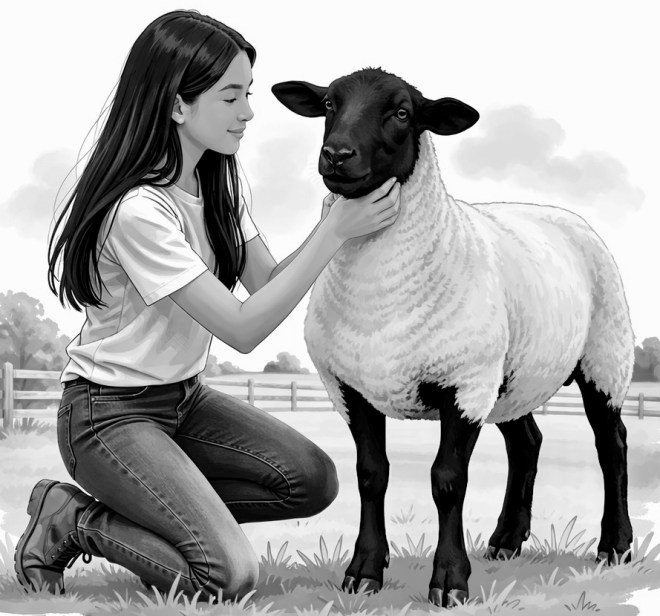
This may fall into the category of Kristi Noem, so reader beware. There were many of my teen years where I was the only kid home to do the chores. The chores on our farm involved feeding the sheep–lugging burlap bags of feed, baled hay, or buckets of grain to the corrals or pens where the sheep were kept. We had a barn and cattle corrals that we had converted to hold sheep–ewes to be kept separate from the rams, weaned lambs kept separate and fed slightly different rations than the others.
In the shed we kept our “show sheep” which were the rams and ewes that we would take to the fairs and contests for 4-H or FFA. Each one of us kids had our particular breeding ewe and/or ram. We didn’t name our sheep unless they were “chosen” and my breeding ewe was named Guinevere after the maiden in King Arthur. Guess what I had been reading at the time…
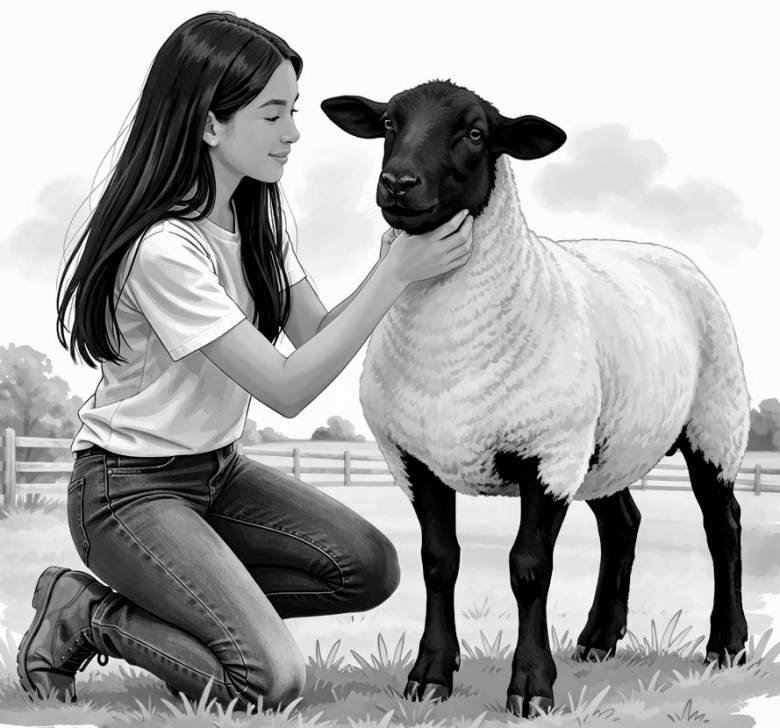
So Guinevere had been my show ewe for several years. She was a bit cantankerous and bull headed. I participated in a contest called Showmanship where the contestants had to show other people’s livestock. Guinevere was my go-to girl–she was hard to handle, had a mind of her own, and few kids could manage her. I held her firm and for me she held steady, but other kids were more timid, and Guinevere would muscle her way out of their grasp or lean into them until they would topple over. I won several contests because of her bad behavior. That was ok by me–she did what I wanted her to do and that’s all that mattered. I didn’t win the contest–Guinevere did.
Now the way most of the kids won their category was because their animal was tame and obedient. Like a dog on a leash, a showman lead a beef steer around. It stopped when the showman stopped, and then the showman’s job was to present the animal in the best light possible for the judge to see.
The dairy cow process was slightly different–instead of walking the cow like a dog, the showman walked backwards. Don’t ask me why. A hog was guided with a cane–taps on the left or right side of the head directed the pig one way or another. A cane horizontally across the eyes was a sign to stop. Well trained hogs would be easy to handle this way. Sheep didn’t have a halter–a firm grip under their chin was the guiding hand. Many a time a hog or sheep would escape their handler if the grip or cane didn’t do the job.
Mike Mehling had a palomino colored horse who was the counterpart to Guinevere. That horse didn’t like anyone but Mike. It would toss its head, stomp its feet, skitter sideways. Mike was the only person who could handle that horse, and consequently he won the horse showmanship competition. The final contest was showing all the animals of all the winners in their category. It was usually a beef animal, dairy cow, hog, sheep and horse.
Mike was a year younger than I. The first year we competed against each other my Guinevere was his nemesis. I had been watching Mike show his horse, and I knew it was going to be a challenge. I think horses are smarter than sheep, and Mike’s horse was docile as a lamb (pun intended) around Mike. I didn’t see any hand or body movements on the part of Mike that made a difference. The horse just knew who Mike was.
So I took a different tact. I didn’t try to control the horse. I just talked. I put my hand on its nose, let it smell me, and talked non-stop in a calm, low voice. I angled so it had a clear view of where Mike stood. It wasn’t as calm with me as it was with Mike, but it was calm enough and did what I needed it to do to come out on top.
That year I won the showmanship contest, Mike came in second. The next year it was a a rematch. I was feeling pretty cocky, knowing I had figured out Mike’s horse. But Mike was no slacker. He had been observing Guinevere, and took a firm hand. She stood for him. I knew it was close. The competition was at the end of the day, and it was closing in on 10 pm at night.
I had to show the beef steer, and Mike was with the dairy cow. Other contestants were with our animals, and we were almost done. Both Mike and I were on the back stretch with the easy animals. When showing a beef animal, the showman had a show stick–a long pole with a blunt nail on the end. It was used to position the feet and also to sooth the animal by rubbing the nail against the animal’s belly. I was keeping my eye on the judge, rubbing the steer’s belly when, before I could jerk him to attention, my steer LAID DOWN.
Well, that was the end of that. Mike won that showmanship contest. He deserved it, and after all, I had won the year before.
Guinevere was a prize ewe. She was worth a lot because she won a lot. I didn’t feel love for her, but I would describe our relationship as respectful. It was like she knew her worth, and she was valuable.
It was fall when I was feeding her and several other show stock. We had changed up the rations to high fiber barley grain spiked with wheat. In my little brain, I figured that if the wheat was good for the livestock, more of it would be better. I kept decreasing the barley and increasing the wheat, until, well… I killed Guinevere. I think the wheat, without the roughage, bound up her insides and killed her.
I didn’t tell my dad for several days. Not good for a dead animal. She lay looking like she was asleep. Finally, I coughed out the confession and told my dad at the kitchen table. He didn’t say much but he was grim. We walked out together to the pen where Guinevere lay, stiff as a board, flies around her eye slits.
And then Daddy said, “Skin her.”
We were farmers, and nothing went to waste. We often would skin the dead animals to save the pelt. I don’t know how much we got for a skin, but it I knew it wasn’t about the money. It was a life lesson.
I cried while I struggled to drag poor Guinevere out of the pen. I remember rolling her on her back in the area between the shed and the little building we kept the horse saddles and bridles. I had skinned other animals, so I knew the process. My dad stood and watched me cut the skin at the belly, down the legs, around each limb. I can hear the tearing as I pulled the pelt from the rear to her head, exposing the layer of fat across her back. She was stiff, but not yet rotting. The tears and snot were flowing from me as I cried and mourned what I had done to her.
It was a severe punishment I will never forget. It was also such an intimate last gesture. She had given me so much, had won competitions for me. In a strange way I look back and recognize the power of the moment ingraining in me the weight of the responsibility I had for the livestock that supported not only me but the family. We were a farm family, and with farming and raising livestock comes life and death. Guinevere wasn’t the first animal I had had to dispose of. Every animal on our farm had to be taken to a “graveyard” of dead animals. We didn’t have, like some places in the midwest, a rendering plant nearby that would pay for the dead animals. Nature took its course.
I continued showing sheep for a few more years, but never had a connection with another sheep like Guinevere. She had been special. I graduated from high school, went on to Stanford, worked at the largest agri-business corporation in the world. I chose the city life instead of the country life. Worked at making business decision, not life and death issues like we did on the farm with livestock.
Life can be cruel. Mike married a local girl, and they farmed in the North Valley. He flew a crop duster as a side business. Mike died in a plane crash not far from his home, He was probably no more than 30 years old.
I am old. There haven’t been that many animals in my life since Guinevere. A few horses, cats, dogs. The farm sold off the sheep a few years after I left home and my dad passed away. I’ve had a lifetime of interesting, character-building events in my life.
Guinevere was one of them.


Love your writing , my dear! Sold your Sante Fe house. Where next?! Cheers,SandySent from Sandy
LikeLike
Liked this story, very different childhood…ChiyoSent from my iPad
LikeLike
Thanks for your insightful, frightening (for a city girl) story.
Kathy Kathryn.Hartley@gmail.com 13500 N Rancho Vistoso Blvd. #337 Oro Valley AZ 85755 520-820-5063
LikeLike